The Air Jordan: The NBA Fine That Built a $4 Billion Business
When Nike signed an unproven rookie named Michael Jordan in 1984, the company was a distant third in the basketball-shoe market. Then the NBA banned the shoe. Then Nike paid the fine. The combination created the most valuable single product line in apparel history.
By The Biz Vault Editorial
In the summer of 1984, Nike was a struggling company with a basketball problem. The brand's founders — Phil Knight and Bill Bowerman — had built Nike around running shoes, and on that front the business was healthy. In basketball, however, Nike was a distant and slipping third behind Converse, which dominated the legacy market with the Chuck Taylor and various endorser-led models, and Adidas, which had positioned itself as the premium European choice. Nike's basketball division was losing money, the company's basketball revenue had dropped roughly 35 percent in the previous year, and Knight was actively considering shutting the line down.
That summer, a twenty-one-year-old North Carolina junior who had declared early for the NBA draft was looking for a shoe contract. His name was Michael Jordan. He had been a college star, had won a national championship, and had played on the gold-medal-winning American Olympic team. He preferred Adidas. He had no particular interest in Nike.
The eighteen-month sequence that followed — Nike's pursuit of Jordan, the launch of the first Air Jordan shoe, the NBA's decision to ban it, and Nike's response — produced what is, by almost any metric, the most successful single product launch in the history of consumer goods. It also did so largely by accident.
The deal Jordan didn't want
Nike's basketball-marketing team, led by an executive named Sonny Vaccaro, had been tracking Jordan since his freshman year at North Carolina. Vaccaro had told Phil Knight, repeatedly, that Jordan was the player to bet the basketball division on. Knight had been sceptical — endorsement spending on a rookie was unusual, and the salary numbers Vaccaro was suggesting were larger than Nike had ever paid an athlete.
When Nike formally pitched Jordan in the summer of 1984, the offer was, by 1984 standards, extraordinary: a five-year deal worth $2.5 million, plus royalties on a signature shoe line. Adidas, the brand Jordan actually wanted, offered roughly a third as much. Converse, the dominant basketball brand, offered him a standard contract roughly equivalent to what they paid their other endorsers — Larry Bird and Magic Johnson — and made it clear that Jordan would be one of several stars on the roster, not the centrepiece.
The deciding factor was Jordan's mother, Deloris, who insisted he take the meeting with Nike despite his preference for Adidas. After the meeting, she told her son to sign with Nike. He signed reluctantly. The contract included a clause — unusual for the period — that gave Jordan a share of every pair of his signature shoes sold, in perpetuity.
The shoe that broke the rules
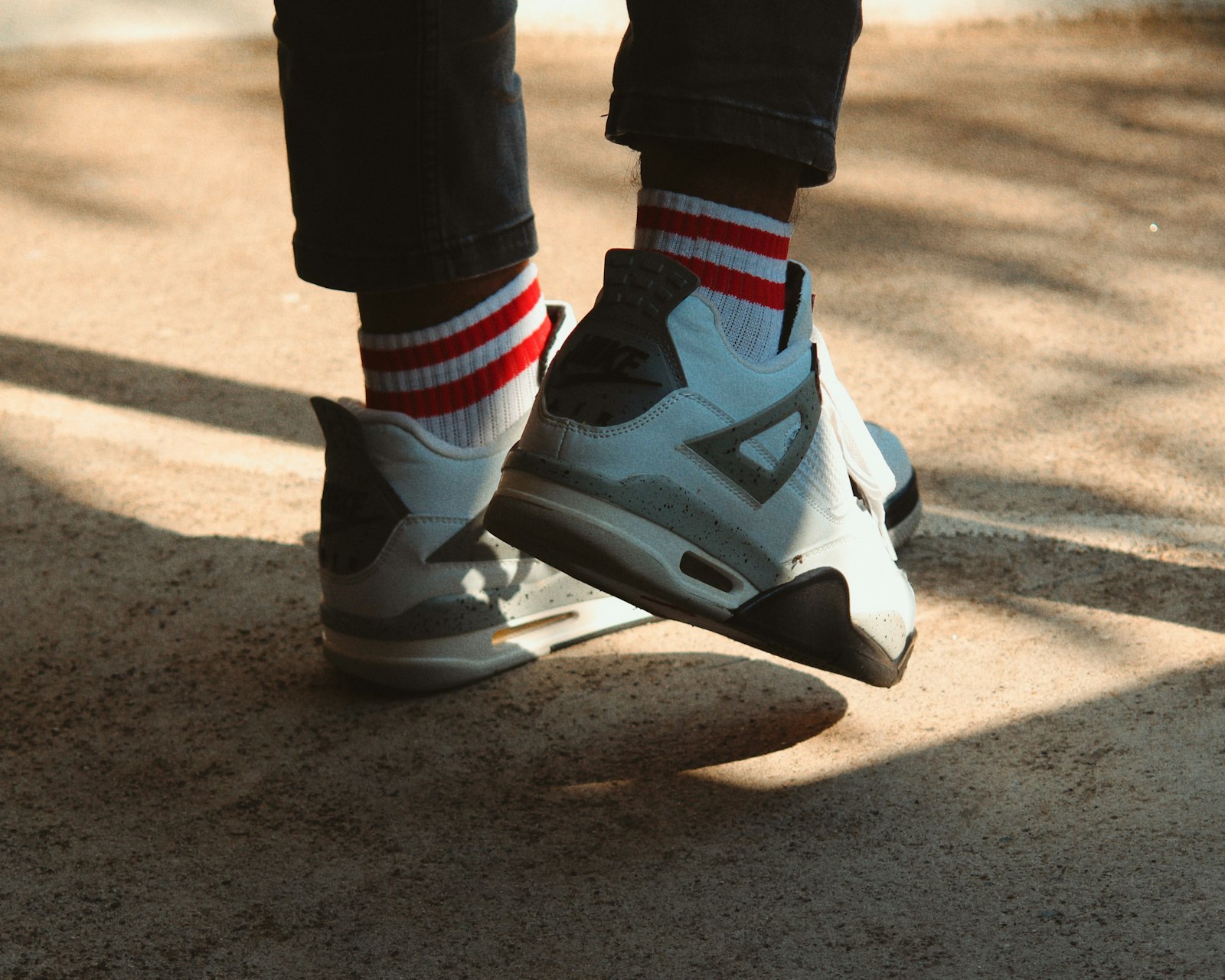
Nike's design team, working with Jordan's input, produced a basketball shoe that was, by 1984 NBA standards, visually radical. The first Air Jordan was black and red. NBA shoes of the period were almost universally white, with at most modest accent colouring. The league's uniform code required that players' shoes match the team's primary colours and contain at least 51 percent white surface area on the upper.
The Air Jordan I, in its black-and-red colourway, was the opposite of compliant. The white surface area was minimal. The black-and-red palette had nothing to do with Jordan's team (the Chicago Bulls played in red, white, and black, but the shoe's white was almost absent). The shoe was, in NBA-uniform terms, illegal.
When Jordan wore the shoes in a pre-season exhibition in October 1984, the league office sent Nike and Jordan a written warning. When Jordan continued wearing them in regular-season play, the NBA fined the player $5,000 for each game he wore the shoes. The fines were paid by Nike.
This is the part of the story most people remember. It is also the part that has been mythologised in ways that do not quite match the records. The NBA never actually banned the Air Jordan I as such; it banned the specific colour scheme as non-uniform-compliant. Nike, for legal and marketing reasons, took the shoe to market without the colour-scheme variation that would have made it legal — and ran a national advertising campaign around the controversy.
The campaign's centrepiece was a black-and-white television ad showing the shoe being framed by descending censorship bars while a voice-over noted: On October 15th, Nike created a revolutionary new basketball shoe. On October 18th, the NBA threw them out of the game. Fortunately, the NBA can't stop you from wearing them.
What the controversy actually did
The NBA fine, by itself, was financially trivial — Nike was paying $5,000 per game on a player it was paying half a million dollars per year in endorsement money. The fine was a marketing gift, not a cost. The campaign Nike built around the controversy did three things that the company's executives at the time understood but the market had not yet seen.
First, the campaign created the first basketball shoe in history that consumers wanted to buy because of cultural meaning rather than functional performance. Previous basketball shoes had been sold on durability, traction, and ankle support. The Air Jordan I sold on rebellion. It was the shoe the NBA didn't want you to wear. That framing was new in athletic footwear, and it produced a level of consumer demand that had no precedent in the category.
Second, the controversy gave Nike a reason to position the shoe as a fashion item rather than an athletic product. Within weeks of the launch, Air Jordans were being worn by people who had no intention of playing basketball — by college students, by hip-hop artists, by anyone who wanted the cultural cachet the shoe carried. This crossover from athletic to fashion was structurally important: athletic-shoe sales were limited by the size of the active-player market, but fashion-shoe sales were limited by the size of the entire population.
Third, the campaign established Jordan as a personal brand distinct from his team, his league, and even the sport itself. Most NBA endorsers of the period were second-tier characters in a campaign designed to sell the league. Jordan, through the Air Jordan campaign, became the campaign's primary subject. The team and the league were backdrop. This inversion — the player as the brand, with the league as the platform — would, over the next decade, restructure how athletes and brands related to each other, and eventually how the entire sports endorsement industry was organised.
The economics that resulted
The Air Jordan I sold approximately $130 million in its first year — roughly four times Nike's internal sales projection. Nike had projected the line would do $3 million in its first year. They missed the projection by a factor of forty.
Within a decade, the Jordan line had expanded into a complete sub-brand. The Jordan Brand, formally spun out as a separate Nike subsidiary in 1997, has produced a new flagship signature shoe every year since the original. By 2025, the Jordan Brand was generating annual revenue of approximately $7 billion — more than the entire Adidas basketball division, more than the entire Converse business, more than most NBA franchises — for a single retired player whose endorsement contract had been signed forty years earlier.
Michael Jordan, under the perpetual royalty clause his mother had insisted on in 1984, has continued to receive a percentage of every pair sold for over four decades. His annual income from the Jordan Brand alone — long after his playing career ended — has consistently exceeded $100 million. He is now, according to Forbes, the wealthiest professional athlete in history, primarily as a result of a contract he signed at twenty-one for a brand he didn't initially want to wear.
The lesson that was structural, not lucky
The Air Jordan story is sometimes told as a parable about the value of betting on the right athlete at the right moment. This is true but understates what Nike actually did. Phil Knight's bet was not just on Jordan; it was on a structural insight about how basketball culture would change.
Through most of the twentieth century, basketball had been understood as a team sport, marketed primarily through teams and their cities. Nike's bet — implicit in the size of the Jordan contract, in the design of a shoe that ignored team colours, in the use of an NBA controversy as marketing asset rather than legal problem — was that basketball was about to become a player-driven culture. The team was diminishing as the unit of meaning. The individual player was rising. Whoever owned the relationship with the player would own the consumer relationship.
That bet, made in 1984, has paid back continuously for forty years. It has reshaped the economics of every American team sport, including football, baseball, and most recently soccer. Almost every player-as-brand structure in modern sports — LeBron James's deal with Nike, Cristiano Ronaldo with Nike then with Saudi commercial vehicles, Patrick Mahomes with Adidas — is a direct descendant of what Nike did with Jordan.
The NBA fine, in this light, was not an obstacle Nike overcame. It was the moment the bet started paying off. A league fining a player and a brand for wearing the wrong shoe was the surest possible signal that the cultural meaning of the shoe had escaped the league's control. Nike paid the fine and ran the ad. The rest of the modern sports endorsement industry has been catching up ever since.
Get The Biz Vault weekly
Original reporting and the week's markets, straight to your inbox. Free.