
Henry Ford's $5 Day Was Not Generosity. It Was Turnover Control.
In 1914, Henry Ford doubled the wages of every man on his assembly line and told the press it was a moral act. The truth was that his factory had a 370 percent annual turnover rate, and the math of replacing workers had become more expensive than paying them.
By The Biz Vault Editorial
On the fifth of January in 1914, Henry Ford gathered the press at his Highland Park factory outside Detroit and announced that, effective immediately, the daily wage of every full-time worker on his assembly line would be raised from $2.34 to $5.00. The factory's working day would also be cut from nine hours to eight. The announcement made the front page of every major American newspaper. Editorials in The New York Times, The Wall Street Journal, and the London Times praised Ford as a visionary, a humanitarian, possibly a socialist. He was, almost overnight, the most famous industrialist in the world.
The story Ford told the reporters that morning was that the wage increase was an act of moral conscience. Workers, he argued, deserved to share in the prosperity their labour created. He spoke of dignity, of the right of working people to afford the products they made, of the duty of the wealthy to use their wealth well. The framing stuck. A century later, "Henry Ford paid his workers enough to buy his cars" remains one of the most repeated sentences in American business mythology.
It is also, in almost every respect, false. The wage increase was not philanthropy. It was the solution to an operational crisis that was destroying the company's ability to manufacture cars at all.
The factory that could not keep workers
The Highland Park assembly line — which Ford and his engineers had introduced in 1913 — was the most productive manufacturing system in human history at the time it was built. A Model T that had taken twelve hours to assemble in 1908 could, by late 1913, be assembled in ninety-three minutes. Output per worker had nearly tripled. Production volumes were limited not by demand (which was effectively unlimited; Ford was selling every car he could make) but by Ford's ability to staff the line.
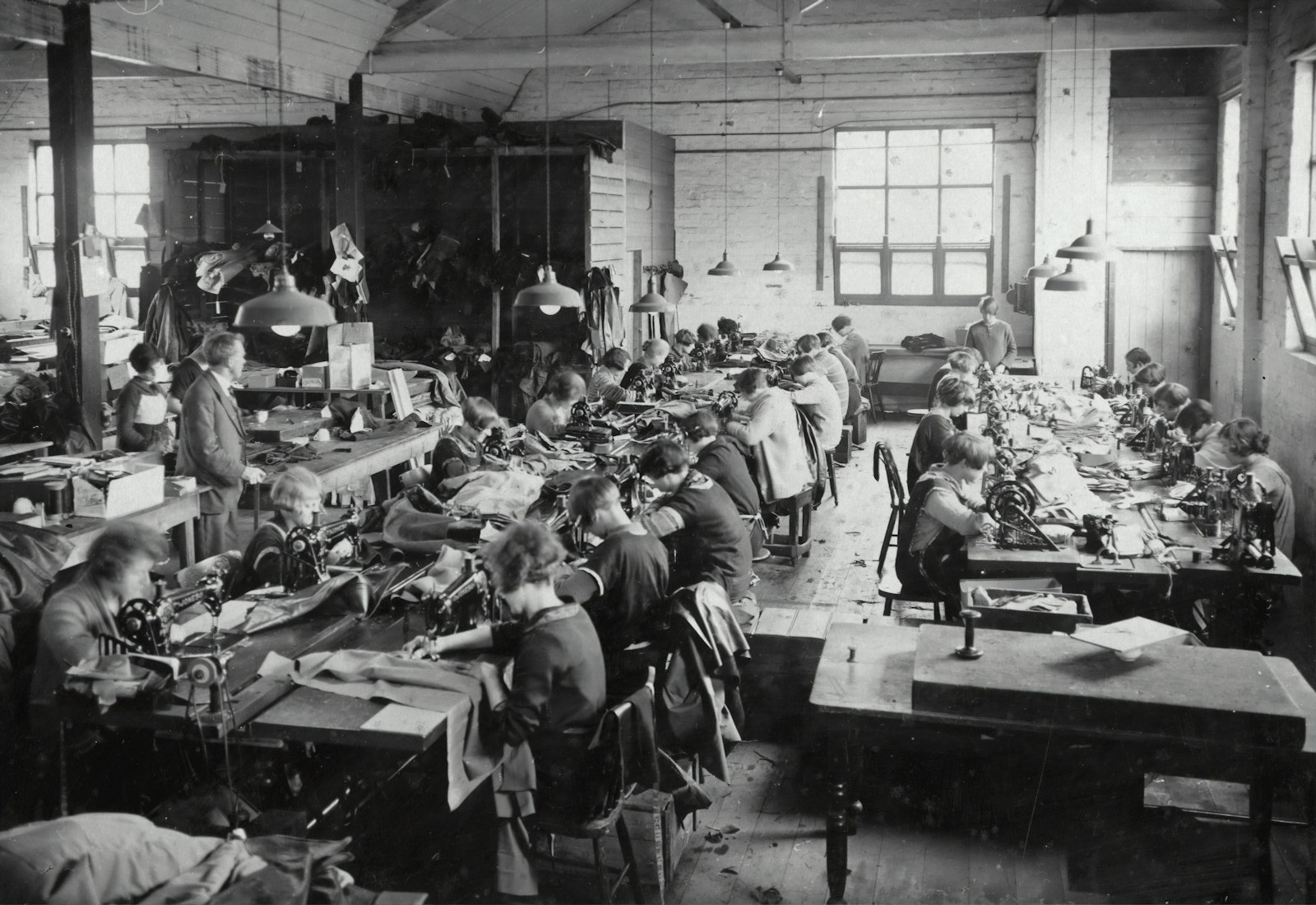
The problem was that almost no one wanted to work on it. The assembly line, in its 1913 form, was psychologically brutal. Each worker performed a single task — tightening one bolt, attaching one wire, fitting one component — for nine hours, at a pace dictated by the line, with no opportunity to vary the work, no conversation possible over the noise, and no slack to take a breath. Workers described it, repeatedly, as soul-destroying. Many quit within their first day.
The 1913 turnover statistics, which Ford's own personnel department compiled in alarm, were extraordinary. The factory's annual turnover rate was approximately 370 percent. To staff a workforce of about 14,000 active workers at any given moment, Ford had to hire roughly 52,000 people per year. New hires were arriving and quitting in such volumes that the personnel department was running, in effect, as a continuous training operation. The factory's productive capacity was being held back not by the line's design but by the cost of constantly bringing new workers up to speed.
The internal financial analysis Ford's executives produced in late 1913 was unambiguous. The cost of training, lost productivity from inexperienced workers, and the recruiting overhead was approaching $50 per replacement, multiplied across tens of thousands of replacements per year. The total annual cost of turnover was approaching $2.5 million — at a time when Ford's annual profit was approximately $25 million. Ten percent of the company's profit was being eaten by churn.
The actual decision
The $5 day was conceived, debated, and approved by Ford's senior management in late 1913 as a turnover-reduction intervention. The internal memos that survive are explicit. The new wage was set high enough to make leaving a Ford job a financially significant decision for the worker. Workers who would, at $2.34 a day, walk off the line after a bad shift would, at $5.00 a day, think twice and stay.
The eight-hour workday was added to the package not for moral reasons but operational ones. Reducing the workday from nine to eight hours allowed Ford to run three eight-hour shifts instead of two nine-hour shifts, increasing the daily output of the factory by about a third without expanding the physical plant. The shorter hours also made the work materially less brutal, which compounded the retention effect.
Crucially, the $5 day was not a wage. It was a wage plus a profit-sharing bonus contingent on the worker's behaviour. The base wage remained $2.34. The remaining $2.66 was paid as a daily "profit-share" to workers who met conditions enforced by Ford's newly created Sociological Department — a team of approximately two hundred investigators who visited workers' homes to assess whether they were spending their money "wisely," whether they drank, whether they kept their houses clean, whether their wives worked outside the home, whether they were members of approved religious organisations, and whether they were teaching their children English.
Workers who failed any of these tests had their profit-share withheld. The Sociological Department, in its early years, disqualified roughly twenty-five percent of eligible workers from the full $5 day. The system functioned as a paternalist disciplinary apparatus disguised as a wage policy.
The result Ford got
The intervention worked, as a turnover-control mechanism, almost immediately. Within twelve months, Ford's annual turnover rate dropped from 370 percent to roughly 16 percent. Productivity per worker rose substantially as experienced workers stayed at their stations long enough to become genuinely good at the work. The cost of the wage increase was more than offset by the savings in training and turnover overhead within the first year. By 1915, Ford was producing more cars per worker per year than he had been before the wage increase, at a lower per-car labour cost.
The $5 day was, by any honest reading, one of the most successful operational interventions in American manufacturing history. It just was not what the press release said it was.
What Ford knew and did not say
Henry Ford was, by most accounts of his contemporaries, a man genuinely uninterested in the moral framing his publicists used to describe his decisions. He was an operations engineer with strong opinions about social control, antisemitism, and the value of repetitive work as a moral discipline. He believed deeply that the assembly line was good for the workers who endured it. He did not believe, in any conventional sense, in worker dignity as the press imagined it.
What Ford did believe was that workers were a manageable input — that, with the right combination of pay, surveillance, and routine, you could produce a stable, productive labour force at a known per-unit cost. The $5 day was an experiment in that management theory, and it succeeded. The fact that the press chose to interpret it as humanitarian was, from Ford's perspective, useful. He did not correct them.
The narrative that Ford paid his workers enough to buy his cars — the one most often cited as his innovation — first appeared in editorials by labour-friendly journalists in early 1914 who were trying to extract a moral lesson from the wage increase. Ford never said it. Some Ford executives have, in subsequent decades, denied he ever endorsed the framing. The mythology took on a life of its own because it produced a satisfying story: an industrialist who recognised that his workers were also his customers, and who acted on that recognition. Ford's actual reasoning — that workers were quitting too fast and the cost of training was eating profit — produced no such uplift, and so the mythology was preferred.
The pattern operators should recognise
The lesson the $5 day actually teaches is one most modern operators learn the hard way and then forget. It is this: high turnover is almost always more expensive than the wage increase that would prevent it, and the cost is almost always invisible on the financial statements until someone forces it to be measured.
Ford's accounting team, in late 1913, were the ones who forced the measurement. They sized the turnover cost. They modelled the wage increase against the savings. They recognised that the apparent labour cost on the income statement (the wages line) was lower than the true labour cost (wages plus the un-recognised cost of churn and training). They proposed the intervention because the numbers, properly reckoned, demanded it.
Most companies do not do this exercise. They treat the wage line as the true cost of labour, optimise to reduce it, and absorb the cost of turnover as a series of unbudgeted line items scattered across recruiting, training, lost productivity, error rates, and management overhead. Each of these is uncomfortable to measure individually and almost never aggregated. The cumulative cost is real but invisible.
The companies that have replicated Ford's actual move — Costco, In-N-Out Burger, Trader Joe's, more recently Amazon's warehouse-wage increases of 2018 — have done so because they sized the cost of turnover honestly and acted on the math. None of them, to be clear, have made the moral framing the centre of their internal story. The moral framing is what the press picks up. The actual decision is operational, and it has been the same operational decision since Henry Ford made it in January of 1914.
Get The Biz Vault weekly
Original reporting and the week's markets, straight to your inbox. Free.